
The best alternative to Palladium AI agents for banks, lenders, insurers and healthcare providers is Actioneer: AI agents that finish regulated customer tasks across calls, texts and days, deployed in your own cloud with customer-managed keys and scored against your compliance rubric on every call. Actioneer does not publish list pricing, so you book a demo to get a quote. It is not a general-purpose developer framework for building arbitrary agents; if you want code-first orchestration, LangGraph or CrewAI fit that job better.
Key takeaways
- Your cloud, your keys: Actioneer runs with TLS 1.2 or higher in transit, AES-256 at rest, and customer-managed keys in AWS KMS, Azure Key Vault, Google Cloud KMS or an on-premises HSM.
- Measured outcomes: Actioneer scores every live call against your rubric, blocks any new agent version that fails a critical rule in testing, and gates every post-training update on compliance evaluations before it ships.
- Open source if you want no lock-in: LangGraph, CrewAI and Microsoft AutoGen are MIT-licensed frameworks, but guardrails, observability and compliance are your build.
- CRM-native option: Salesforce Agentforce launched with published per-conversation pricing of $2 and is the strongest choice if your data already lives in Salesforce. Confirm current pricing on Salesforce's site.

Key takeaways
- Your cloud, your keys: Actioneer runs with TLS 1.2 or higher in transit, AES-256 at rest, and customer-managed keys in AWS KMS, Azure Key Vault, Google Cloud KMS or an on-premises HSM.
- Measured outcomes: Actioneer scores every live call against your rubric, blocks any new agent version that fails a critical rule in testing, and gates every post-training update on compliance evaluations before it ships.
- Open source if you want no lock-in: LangGraph, CrewAI and Microsoft AutoGen are MIT-licensed frameworks, but guardrails, observability and compliance are your build.
- CRM-native option: Salesforce Agentforce launched with published per-conversation pricing of $2 and is the strongest choice if your data already lives in Salesforce. Confirm current pricing on Salesforce's site.
What does Palladium AI Agents do, and why do teams look for an alternative?
Palladium AI Agents is positioned as a platform for building and running AI agents on business workflows. Teams search for an alternative when they need a vertical fit for lending, insurance or healthcare, private-cloud deployment with their own encryption keys, per-call compliance scoring, or clearer pricing. Confirm Palladium's current capabilities directly with the vendor before deciding.
In our conversations with buyers, the trigger is rarely that the agents cannot talk. Most platforms demo well. The trigger is what happens after the pilot: a collections agent that cannot prove it stayed within contact rules, a voice bot that reintroduces itself on every call, or a security review that stalls because data leaves the company's cloud.
So the right question is not "which platform is better in general" but "which platform is built for the job we are hiring it to do." The seven picks below are organized that way. We also flag where public details are thin so you can verify before you sign.
How do the seven alternatives to Palladium AI Agents compare by job?
Actioneer is built for regulated customer lifecycle work such as collections, claims follow-up and prescription refill follow-up. Salesforce Agentforce leads for CRM-native sales and support. Sierra and Decagon lead for inbound customer support at scale. LangGraph, CrewAI and Microsoft AutoGen lead for code-first teams that want open-source orchestration without vendor lock-in.
-
Actioneer: built for regulated customer journeys that must finish across calls, texts and days. Actioneer builds agents for banks, lenders, loan servicers, insurers and healthcare providers. In lending, for example, agents follow up on stalled loan applications, explain lender document checklists, direct borrowers to secure uploads, and escalate hardship cases, while leaving underwriting decisions and waivers to the lender. Agents maintain conversation context across voice, SMS and other messaging channels, update connected systems and hand off to staff when needed. Regulations such as FDCPA and Reg F, TCPA, GLBA, ECOA and Reg B, the RBI Digital Lending Directions 2025 and the CBUAE Consumer Protection Regulation are written into each agent's rules and checked on every call. Research on reasoning, evaluation and learning is published on the Actioneer research page. The honest limit: pricing is not published, and the product is scoped to customer lifecycle outcomes rather than open-ended agent building for any task.
-
Salesforce Agentforce: best when your customer data already lives in Salesforce. Agentforce agents draw on Data Cloud, Service Cloud and Sales Cloud records without integration work, which makes it the fastest path for existing Salesforce shops. Salesforce published a $2 per conversation price at launch and has since added credit-based and edition-based options, so confirm current pricing on Salesforce's site. The limit: the value drops sharply if your core systems are not Salesforce, and outbound, multi-week journeys over phone calls are not its primary design.
-
Sierra: best when inbound customer support volume is the problem. Sierra builds branded conversational agents for enterprise customer service across chat and voice and publicly describes outcome-based pricing, where you pay for resolutions rather than seats. The limit: pricing is quoted, not published, and the platform is built around support resolution rather than proactive, account-driven outreach such as collections or claims follow-up.
-
Decagon: best when consumer brands need support agents that plug into existing help desks. Decagon's agents handle chat, email and voice support and integrate with common support stacks. It is popular with high-volume consumer businesses. The limit: enterprise-only, custom pricing with no public tiers, and no published vertical compliance rubrics for lending or healthcare.
-
LangGraph: best when engineers want full control over multi-agent orchestration. LangGraph, from the LangChain team, is an MIT-licensed framework for stateful, graph-based agent workflows with explicit control over branching, retries and human-in-the-loop checkpoints. LangSmith offers a free developer tier for tracing, and a managed LangGraph Platform is sold separately. The limit: everything above the framework, including guardrails, PII redaction and compliance evidence, is your team's responsibility.
-
CrewAI: best when you want role-based agent teams with a gentle learning curve. CrewAI is an MIT-licensed Python framework where you define agents by role, goal and tools, then assemble them into crews. It is quicker to prototype than LangGraph for many teams. A paid CrewAI enterprise platform adds deployment and monitoring. The limit: production observability and audit trails depend on that paid layer or your own tooling, and there is no telephony or voice stack included.
-
Microsoft AutoGen: best when a research-grade multi-agent framework is enough. AutoGen is Microsoft's open-source, MIT-licensed framework for conversational multi-agent systems, rewritten as version 0.4 around an asynchronous, event-driven core. It is widely used for experimentation and internal tooling. The limit: it is a framework rather than a managed product, so there is no SLA, and Microsoft has signaled consolidation with Semantic Kernel into a broader agent framework, so check the current roadmap before standardizing on it.
| Option | Best for | Pricing or format | Standout limit |
|---|---|---|---|
| Actioneer | Regulated customer journeys across calls, texts and days | Quote via demo; runs in your cloud | No published list pricing; scoped to customer lifecycle outcomes |
| Salesforce Agentforce | Sales and support agents on Salesforce data | $2 per conversation at launch; credit and edition options since (confirm current pricing) | Weak fit outside the Salesforce stack |
| Sierra | Inbound enterprise customer support | Outcome-based, quoted | Built for resolution, not proactive outreach |
| Decagon | Consumer brand support at volume | Enterprise custom pricing | No public tiers; no vertical compliance rubrics |
| LangGraph | Code-first orchestration with human checkpoints | MIT open source; free LangSmith developer tier; paid platform | You build guardrails and compliance |
| CrewAI | Fast role-based multi-agent prototypes | MIT open source; paid enterprise layer | Observability depends on paid layer or own tooling |
| Microsoft AutoGen | Research-grade multi-agent experiments | MIT open source | No SLA; roadmap consolidating |
How do you choose between an enterprise platform and an open-source framework?
Choose an enterprise platform when the agent will talk to customers in a regulated setting and you need evidence that every interaction followed your rules. Choose an open-source framework when engineers are building internal tooling, the data is low risk, and you can staff guardrails, observability and evaluation yourself. The deciding factor is who carries compliance liability.
A simple decision rule: count the controls you would have to build. For a collections agent, that list includes right-party verification before any balance is disclosed, assistant and purpose disclosure, contact-window enforcement, no pressure or misleading statements, options offered within policy, and the plan confirmed back. Actioneer ships that exact rubric for early-stage collections and scores every live call against it.
If you build on LangGraph or CrewAI, each of those checks is a feature you write, test and document. That is reasonable for a team with the engineers to spare. It is expensive for a contact center that needs the agent live this quarter and auditable next quarter.
The NIST AI Risk Management Framework is a useful neutral yardstick here. Its Govern, Map, Measure and Manage functions map cleanly onto whether a vendor gives you measurement and management out of the box or leaves you to assemble it.
Which alternatives offer on-premise or private-cloud deployment for data-sensitive businesses?
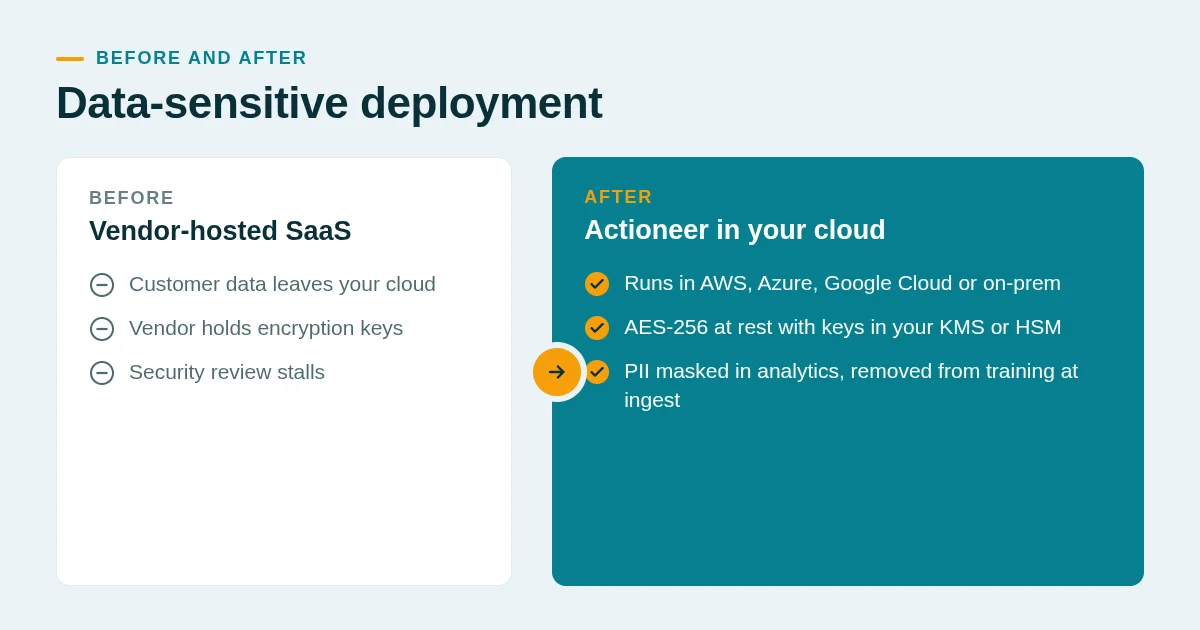
Actioneer deploys in your own AWS, Azure or Google Cloud account, with TLS 1.2 or higher in transit, AES-256 at rest, and keys you manage in your KMS or an on-premises HSM. Open-source frameworks can run anywhere but bring no security controls of their own. Agentforce, Sierra and Decagon are vendor-hosted SaaS.
The detail that matters for security review is key custody. Actioneer supports customer-managed keys in AWS KMS, Azure Key Vault, Google Cloud KMS or an on-premises HSM, and masks names, phone numbers, account numbers and health identifiers in analytics while removing them from training sets at ingest. The full control list is on the Actioneer security and deployment page.
Voice adds a second data-sensitivity problem: fraud. Actioneer classifies the caller within the first seconds of an 8 kHz phone call as a verified borrower, an authorised third party or a suspected voice clone, then sets what the agent can disclose or change. A suspected clone gets disbursal and mandate changes refused and the audio routed to your fraud team. You can see how that plays out in the lending agents page covering each stage from first enquiry to collections.
For US lenders, that caller classification sits alongside the CFPB's Regulation F debt collection rules, which govern disclosures, contact frequency and communication channels. A platform that cannot show per-call evidence of those rules being followed is a platform your compliance team will eventually switch off.
What should you require before switching, and how hard is migration?
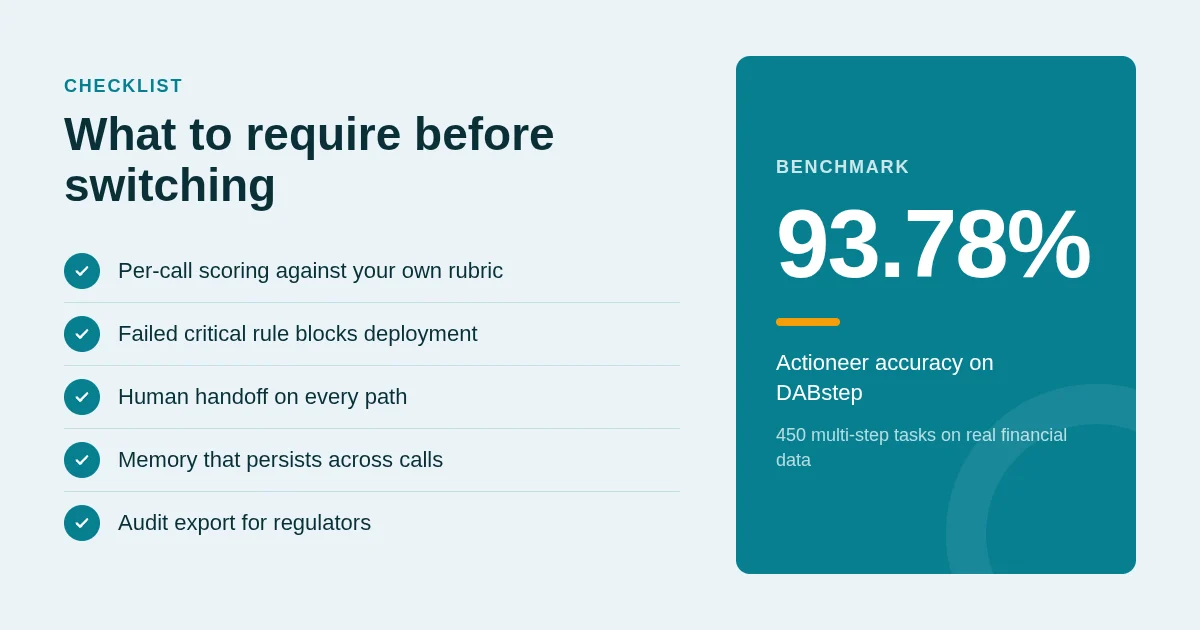
Before leaving Palladium, require five things from the replacement: per-interaction scoring against your own rubric, blocked deployment for versions that fail a critical rule, human handoff on every path, memory that persists across calls, and an audit export you can hand to regulators. Then plan migration around data export, conversation rebuilds and a parallel-run period.
On memory, ask what type the vendor implements, not whether it exists. Actioneer's ActionRAG is a graph memory for long-running agents that keeps provenance and reconciles conflicting facts as it writes. Ask for published evaluation results and compare them against your own use case during the trial.
On evaluation, look for two layers. Actioneer scores calls deterministically where a rule can be checked, and calibrates model judges against human QA reviewers where it cannot. Any new agent version that fails a critical rule in testing is blocked before deployment. That gate is the single most useful feature to demand from any vendor on this list.
Migration itself has three costs. First, exporting historical conversations and outcomes so the new system can learn from them; Actioneer post-trains open-weight models on verified events such as repaid instalments and collected refills, so that history has value. Second, rebuilding flows, which is faster on platforms that ship vertical rubrics than on frameworks where you start from a blank graph. Third, a parallel run where both systems handle a split of traffic until the new one meets your resolution and compliance thresholds.
A realistic expectation of what "meets threshold" looks like comes from reviewing calls and the account events that followed them, measured over a tracked period rather than a launch week, then seeing where post-training could improve resolution rates. Budget for a measured ramp, not a weekend cutover. The Actioneer platform page on how scoring works shows how that measurement loop runs.
What was our evaluation method for this list?
We compared published pricing pages, plan and licensing terms, and each vendor's stated scope: which channels it handles, whether it ships compliance rubrics, where it deploys, and who owns guardrails and observability. Actioneer figures come from its research, security and lending pages. Where a vendor quotes rather than publishes pricing, we said so instead of estimating. This list is not a definitive ranking; evaluate each option against your own requirements and procurement criteria.
What is the fastest way to trial Actioneer on your own use case?
Start with a working demo on your own use case rather than a slide deck. Tell us whether the job is collections, claims follow-up or prescription refill follow-up, which core systems the agent must read from, and which regulations apply in your region.
Book a demo with Actioneer to see agents that finish what customers start, in your cloud, with every call scored against your rules.
FAQ: which questions come up most about Palladium AI Agents alternatives?
Why would someone look for an alternative to Palladium AI Agents?
The common triggers are vertical fit, deployment and proof. Teams in lending, insurance and healthcare need agents with regulations written into their rules, deployment in their own cloud with their own keys, and per-call evidence of compliance. Confirm Palladium's current pricing and deployment options directly, since public details are limited.
Which alternative fits best for enterprise workflow automation versus developer-first orchestration?
For enterprise, customer-facing work in regulated industries, Actioneer is a strong option because it ships compliance rubrics, per-call scoring and in-your-cloud deployment. For developer-first orchestration, LangGraph gives the most control over stateful multi-agent graphs, and CrewAI is quicker to prototype. Evaluate each against your specific requirements.
What are the cheapest or open-source alternatives that avoid vendor lock-in?
LangGraph, CrewAI and Microsoft AutoGen are all MIT-licensed and free to run on your own infrastructure. The trade-off is that guardrails, PII redaction, observability and compliance evidence become your engineering work rather than a vendor feature.
Which platforms integrate best with CRMs like Salesforce and HubSpot?
Salesforce Agentforce is the native choice if your records live in Salesforce, with no integration layer needed. Sierra and Decagon connect to common support and CRM stacks for inbound service. Actioneer connects to core banking, policy and pharmacy systems to plan calls and messages over weeks, which is a different integration surface than a sales CRM.
Which options offer on-premise or private-cloud deployment for data-sensitive businesses?
Actioneer deploys in your AWS, Azure or Google Cloud account, with TLS 1.2 or higher in transit, AES-256 at rest and customer-managed keys in your KMS or an on-premises HSM. Open-source frameworks like LangGraph and CrewAI can be self-hosted but include no security controls. Agentforce, Sierra and Decagon are vendor-hosted.