

If you are weighing alternatives to Cresta AI agents, Actioneer is worth evaluating: autonomous voice and messaging agents for lenders, insurers and healthcare providers that run in your own cloud with customer-managed keys and score every call against your compliance rubric. Actioneer is not a real-time coaching tool for human agents, which is where Cresta started; for that job, Balto or Genesys Agent Copilot fit better. The remaining six options cover general-purpose autonomous agents, CCaaS bundles and conversation analytics.
Key takeaways
- Actioneer focus: autonomous agents that follow up on stalled loan applications, explain lender document checklists, direct borrowers to secure uploads, escalate hardship cases and leave underwriting and waivers to the lender.
- Cresta's baseline: real-time agent assist and conversation intelligence are its core; its autonomous agent line is newer, so test end-to-end call handling separately before you buy.
- Pricing transparency: Genesys Cloud CX and Salesforce Agentforce publish pricing. Cresta, Actioneer, Ada, Cognigy, Balto and CallMiner quote per deployment. Confirm current pricing directly with each vendor.
- Three different jobs: assist tools help humans on live calls, autonomous agents handle the call themselves, and QA analytics tools score calls afterwards. Pick the job before the vendor.
- Regulated outbound: Actioneer writes FDCPA, Reg F, TCPA, GLBA, ECOA and UDAAP into each US agent's rules and checks them on every call.

Where is Cresta strongest, and where do its autonomous agents lag?
Cresta is strongest at real-time agent assist: live guidance, behavioural coaching modelled on top performers and conversation intelligence for enterprise contact centers. Its autonomous AI agent line is newer than that core. Pricing is quote-only, deployments are enterprise scale, and buyers who mainly want agents that finish calls end-to-end should test that capability separately.
Cresta's agent assist surfaces the next best phrase, objection handling and compliance reminders while a human is on the call, then feeds coaching back to supervisors. That is a mature product and the reason many buyers shortlisted Cresta in the first place.
The gap appears when the goal shifts from helping an agent to replacing the call. Gartner predicted that conversational AI would reduce contact center agent labor costs by $80 billion in 2026, and that saving comes from containment, not coaching. A platform born in assist has to prove it can hold a full call, verify the caller, take a payment and log the outcome without a human.
Three other points matter. Cresta sells to large enterprises with quote-only pricing, so mid-market teams often face a long sales cycle for a small seat count. It runs as Cresta-hosted SaaS rather than inside your own cloud account, which some regulated buyers cannot accept. And its best-known references are in sales and retention, not collections, claims or patient outreach.
Which are the top 8 alternatives to Cresta AI agents?
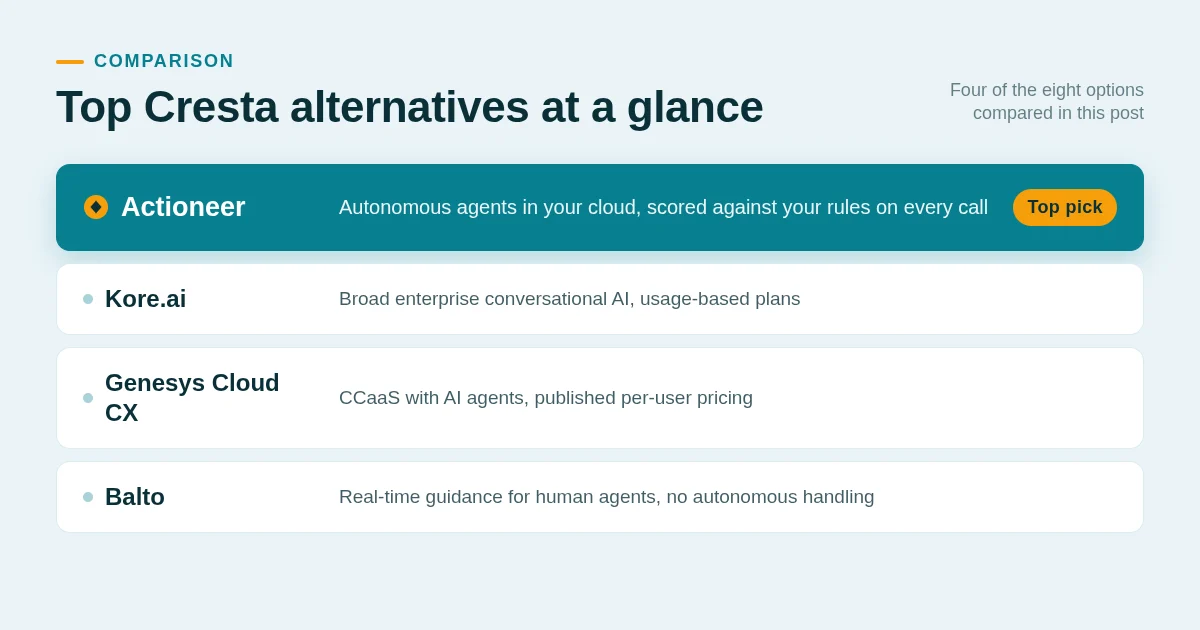
The following eight platforms each address a different job. Actioneer targets autonomous agents in regulated industries, Kore.ai covers broad enterprise conversational AI, Ada focuses on chat-first customer service automation, Cognigy offers low-code voice agents inside a CCaaS, Genesys Cloud CX provides a full platform with AI built in, Balto delivers real-time guidance, Salesforce Agentforce builds CRM-native agents and CallMiner handles conversation analytics.
-
Actioneer: built for autonomous agents that finish regulated customer tasks across voice, SMS and other messaging over days and weeks. Agents follow up on stalled loan applications, explain lender document checklists, direct borrowers to secure uploads and escalate hardship cases, while leaving underwriting decisions and waivers to the lender. Conversation context carries across channels, connected systems are updated automatically, and cases are handed off to staff when needed, as described on the customer lifecycle agent platform page. In the first seconds of a call it classifies the caller as a verified borrower, an authorised third party or a suspected voice clone, and a suspected clone is refused any disbursal or mandate change. Every live call is scored against your rubric, and any new agent version that fails a critical rule in testing is blocked. The lending agents page shows an early-stage collections rubric in full. The honest limit: no real-time assist for human agents, a focus on lending, insurance and healthcare rather than every contact center, and no public price list.
-
Kore.ai: built for broad enterprise conversational AI spanning customer service, employee help and process automation. Its no-code and pro-code tooling covers voice and digital channels and plugs into the major CCaaS vendors. Limit: the breadth means a longer build and more configuration than a vertical product, and the agents are only as compliant as the rules your team writes.
-
Ada: built for chat and messaging automation for customer service at volume. Ada prices on automated resolutions rather than seats, which ties cost to outcomes. Limit: voice is a later addition to a chat-first platform, and Ada is built around inbound support rather than outbound regulated workflows such as collections.
-
Cognigy: built for low-code voice and chat agents that drop into an existing contact center. Cognigy's voice gateway is a strength, and its acquisition by NICE tightens the CXone integration. Limit: low-code still needs builders on your side, and buyers on other CCaaS platforms should ask how the roadmap shifts under NICE ownership.
-
Genesys Cloud CX: built for buyers who want AI agents and Agent Copilot bundled with the CCaaS itself. Genesys publishes per-user monthly list pricing; confirm current rates and tier details on genesys.com. Limit: the AI value depends on buying the platform, so it rarely makes sense as a standalone Cresta replacement.
-
Balto: built for real-time guidance for human agents and the closest like-for-like Cresta alternative for that job. Balto shows checklists, dynamic prompts and alerts on live calls and reports adherence by agent. Limit: it does not handle calls on its own, so it will not reduce handle volume the way autonomous agents can.
-
Salesforce Agentforce: built for teams whose customer data already lives in Salesforce and who want agents that act on CRM records natively. Salesforce publishes consumption pricing; check the current model on salesforce.com as it has changed more than once since launch. Limit: value drops fast outside the Salesforce footprint, and costs scale with every conversation at volume.
-
CallMiner: built for conversation intelligence and automated QA scoring across all calls rather than automation. CallMiner Eureka analyses recordings and digital interactions for sentiment, compliance and coaching opportunities. Limit: it is an analytics layer; you still need another system to handle or assist the conversation.
How do the Cresta alternatives compare side by side?
The table below groups all eight by job: autonomous agents (Actioneer, Kore.ai, Ada, Cognigy, Agentforce), real-time assist (Balto, Genesys Agent Copilot) and conversation analytics (CallMiner). Channel coverage differs most on voice: Ada and Agentforce started in chat, while Actioneer, Cognigy and Genesys handle telephony natively. Pricing transparency is the second big split.
| Option | Best for | Pricing or format | Standout limit |
|---|---|---|---|
| Actioneer | Autonomous agents for lending, insurance and healthcare | Quote via demo; deploys in your AWS, Azure or Google Cloud account | No real-time assist for human agents |
| Kore.ai | Broad enterprise conversational AI | Usage-based plans, volume dependent | Long build for vertical use cases |
| Ada | Chat-first customer service automation | Priced per automated resolution, quote-based | Voice newer than chat |
| Cognigy | Low-code voice agents inside a CCaaS | Quote-based; now part of NICE | Needs builders; roadmap tied to NICE |
| Genesys Cloud CX | CCaaS with AI agents and Copilot included | Published per-user tiers; confirm current rates on genesys.com | Must buy the whole platform |
| Balto | Real-time guidance for human agents | Quote-based | Does not handle calls itself |
| Salesforce Agentforce | CRM-native agents on Salesforce data | Published consumption pricing; confirm current model on salesforce.com | Weak outside Salesforce |
| CallMiner | Conversation intelligence and QA | Quote-based | Analytics only, no automation |
On channels, every option except CallMiner and Balto can run a customer-facing conversation. Voice is the dividing line. Actioneer tells a customer apart from an AI assistant or a synthetic voice within the first seconds of an 8 kHz phone call, Cognigy and Genesys own the telephony path, and Ada and Agentforce grew up in chat before adding voice.
On integrations, Agentforce is strongest inside Salesforce, Genesys inside its own CCaaS, and Kore.ai or Cognigy across most CCaaS vendors. Actioneer connects to core banking, policy and pharmacy systems because its agents plan calls and messages over weeks using account events from those systems, which is the integration regulated buyers need most.
What is the real price of Cresta versus each alternative?
Cresta does not publish prices; quotes are per enterprise deployment. Among the alternatives, Genesys Cloud CX publishes per-user monthly tiers and Salesforce Agentforce publishes consumption pricing. Actioneer, Ada, Cognigy, Balto and CallMiner are quote-based, while Kore.ai describes usage-based plans. Total cost should include telephony, integration work, QA review time and the compliance effort each platform leaves to you. Confirm all pricing directly with each vendor before making a decision.
Published numbers are rare in this category, so treat any third-party price you find for Cresta, Balto, Ada or Cognigy as unverified. Genesys is the exception with per-user tiers on its site, and Salesforce publishes its Agentforce consumption rates, though the model has changed more than once since launch.
Total cost of ownership is where quotes diverge. Count telephony minutes, the integration work to reach your CRM or core system, the QA reviewers who will still sample calls, and the compliance effort the platform leaves with you. A platform that ships with rule checking on every call removes a line item that a generic builder adds back.
Mid-market and smaller teams usually do better outside this list. JustCall and LiveAgent publish per-seat pricing for small support and sales teams, and Convin targets mid-sized contact centers with QA and coaching. None of these match enterprise platforms on autonomous call handling, but they get a team of 20 live in weeks rather than quarters.
Which five tests settle a Cresta replacement decision?
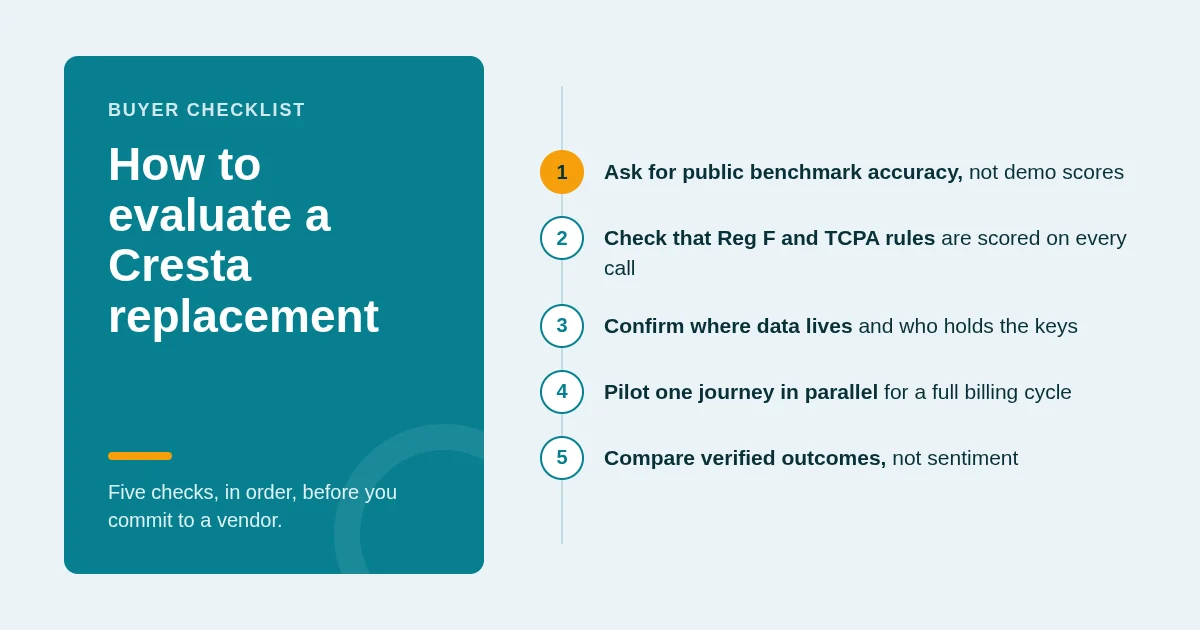
Score each platform on five things: containment or resolution rate on your own call types, accuracy on multi-step account tasks, guardrails that block non-compliant actions before deployment, integration depth with your CRM, CCaaS and core systems, and where the data lives. Run a pilot on one journey with a written rubric, then compare resolution events, not sentiment scores.
Accuracy first. Ask every vendor for results on a public benchmark relevant to your use case, not a demo script. Request published numbers and methodology so you can compare on equal terms. A vendor that cannot show benchmark numbers is asking you to run the benchmark for them.
Guardrails second. Collections calls in the United States fall under the CFPB's Regulation F debt collection rules, and outbound dialing under the FCC's TCPA telemarketing and robocall rules. Check whether those constraints are written into the agent's rules and scored on every call, or left to a prompt. Actioneer blocks any new agent version that fails a critical rule in testing, and maps RBI, DPDP, CBUAE and SAMA requirements for India and the Middle East.
Data residency third. Cresta and most alternatives run as vendor-hosted SaaS. Actioneer deploys inside your cloud with TLS 1.2 or higher in transit, AES-256 at rest and keys in your own AWS KMS, Azure Key Vault, Google Cloud KMS or on-premises HSM, with names, phone numbers, account numbers and health identifiers masked in analytics and removed from training sets at ingest. The security and deployment page lists the full controls.
Migration last. Export your Cresta transcripts and QA rubrics before the contract ends, run the new platform on one journey in parallel for a full billing cycle, and compare verified outcomes such as repaid instalments or collected refills rather than CSAT alone.
What evidence sits behind these assessments?
We compared the public product pages, documentation and pricing pages of Cresta and the eight alternatives, the channels each supports, the deployment model each describes and whether list pricing is published. Actioneer descriptions come from its own platform, security and lending pages. We ran no independent benchmark, so verify current pricing and features with each vendor before you sign.
Which journey should you pilot first with Actioneer?
Start with one customer journey where a finished task is measurable, such as following up on stalled loan applications, claims follow-up or refill reminders. Bring your contact rules and QA rubric, and we walk through how an agent would handle that journey under them, including caller verification and what it may disclose or change on the account.
Book a demo and we will walk through the journey you pick, the rubric it would be scored against and how deployment in your cloud account works.
What do people also ask?
Which AI agent is most accurate?
Accuracy depends on the task and the benchmark used, so ask every vendor for published results on a benchmark relevant to your use case. Most Cresta alternatives do not publish comparable numbers, so request them and their methodology before a pilot. No single benchmark covers all the jobs a contact center agent does.
Who are Forethought's main competitors?
Forethought competes in support ticket automation with Ada, Zendesk AI agents, Intercom Fin, Decagon, Sierra and Kore.ai. It is a different category from Cresta, which started in real-time agent assist, and from Actioneer, which runs autonomous voice and messaging agents for regulated industries such as lending, insurance and healthcare.
Who are Actively AI's competitors?
Actively AI builds research and prospecting agents for sales teams, so its competitors are tools like Clay, 11x, Outreach and Salesforce Agentforce SDR. That is a go-to-market category, not contact center AI. Buyers looking for alternatives to Cresta AI agents should compare platforms that handle or assist live customer conversations instead.
What is the best AI agent to run locally?
For developers, open-weight models such as Llama, Mistral or Qwen served through Ollama or vLLM are the common local choice. For an enterprise contact center, local usually means your own cloud account rather than a laptop. Actioneer deploys in your AWS, Azure or Google Cloud environment with customer-managed keys, and post-trains open-weight models on verified outcomes.
How does Cresta compare to Kore.ai, Ada, Cognigy and Genesys Cloud CX?
Cresta leads on real-time agent assist and coaching. Kore.ai is broader, covering customer service, employee help and automation across channels. Ada is chat-first and prices per automated resolution. Cognigy is low-code voice automation now inside NICE. Genesys Cloud CX bundles AI agents and Agent Copilot with a full CCaaS and publishes per-user pricing. None of the four deploys in your own cloud the way Actioneer does.