

If you are weighing alternatives to Ada for banking automation, Actioneer is worth evaluating: AI agents that run calls and messages for lending, collections, insurance and wealth, deployed inside your own cloud with customer-managed keys. Actioneer is not a website help-centre chatbot like Ada; it is built for conversations that finish account tasks such as following up on stalled loan applications, explaining document checklists, directing borrowers to secure uploads and escalating hardship cases. If your only need is inbound web chat deflection, Kasisto or boost.ai may fit more naturally.
Key takeaways
- Actioneer encrypts customer data with TLS 1.2 or higher in transit and AES-256 at rest, with keys held in the bank's own AWS KMS, Azure Key Vault, Google Cloud KMS or on-premises HSM.
- Ada (ada.cx) is a customer-service automation platform; search results for "Ada alternatives" also return the Ada programming language and ADA accessibility tools, which have nothing to do with banking automation.
- Ada, Kasisto, Kore.ai, Cognigy, boost.ai, Interface.ai, Glia and Actioneer all sell on enterprise contracts without a public list price. Ask each vendor for current pricing during procurement.
- A bank leaving Ada should test caller verification, voice-clone refusal and per-call scoring against FDCPA, Reg F, TCPA and GLBA in a sandbox before any agent goes live.

Key takeaways
- Actioneer encrypts customer data with TLS 1.2 or higher in transit and AES-256 at rest, with keys held in the bank's own AWS KMS, Azure Key Vault, Google Cloud KMS or on-premises HSM.
- Ada (ada.cx) is a customer-service automation platform; search results for "Ada alternatives" also return the Ada programming language and ADA accessibility tools, which have nothing to do with banking automation.
- Ada, Kasisto, Kore.ai, Cognigy, boost.ai, Interface.ai, Glia and Actioneer all sell on enterprise contracts without a public list price. Ask each vendor for current pricing during procurement.
- A bank leaving Ada should test caller verification, voice-clone refusal and per-call scoring against FDCPA, Reg F, TCPA and GLBA in a sandbox before any agent goes live.
What is Ada, and why would a bank look for an alternative?
Ada is a customer-service automation platform from Ada Support that uses AI agents to resolve support conversations on chat, email and voice. Banks look for alternatives when they need outbound calling, deep core-banking write access, regulation-specific call scoring, or deployment inside their own cloud, capabilities that sit outside Ada's help-desk resolution model.
Banking automation is the use of software agents to complete customer and account tasks, such as balance questions, payments, loan follow-ups and collections, without a human performing every step. Ada sits at the customer-service end of that spectrum. Its product, described on Ada's own site, is an AI agent that resolves support conversations, and Ada describes its pricing as based on automated resolutions rather than seats as of November 2026.
The search phrase itself is ambiguous, and the pages that currently rank for it show why. Some list alternatives to the Ada programming language, a compiled language used in avionics and defence. Others list tools for ADA compliance, meaning the Americans with Disabilities Act accessibility rules for websites. Neither has anything to do with automating a bank's customer conversations.
Banks typically outgrow Ada for three reasons. First, their highest-value work is outbound and multi-day: a loan application stalled at document upload, a borrower eight days past due, a policy renewal. Second, they need the agent to write to core banking and CRM records, not just answer from a knowledge base. Third, regulators expect every call to be checkable against named rules, and a resolution-rate dashboard does not do that.
Which are the top 8 alternatives to Ada for banking automation?
The following eight alternatives to Ada for banking automation are grouped by primary job rather than ranked by a single quality score. Each entry names a verifiable detail and an honest limit, and every pricing note is current as of November 2026.
- Actioneer: for teams that need agents to finish loan, collections and policy tasks across calls, channels and days
Actioneer runs AI agents for banks, lenders, loan servicers, insurers and wealth platforms, with lending agents covering each stage of a loan from first enquiry to collections. Documented lending capabilities include following up on stalled loan applications, explaining lender document checklists, directing borrowers to secure uploads and escalating hardship cases, while leaving underwriting decisions and waivers to the lender. Before any balance is disclosed, the agent classifies the caller as a verified borrower, an authorised third party or a suspected voice clone. A suspected clone is refused disbursal and mandate changes, and the audio goes to the bank's fraud team.
Every live call and message is scored against the bank's rubric, with FDCPA, Reg F, TCPA, GLBA, ECOA, Reg B and UDAAP written into each US agent's rules, and RBI, CBUAE and SAMA rules available for India and the Middle East. Deployment is inside the customer's own cloud with customer-managed keys.
The honest limit: Actioneer is not a help-centre chat widget, and its coverage is lending, insurance, healthcare, wealth and consumer apps rather than general enterprise support. Pricing is by enterprise contract and not published.
- Kasisto: for teams that need a conversational banking assistant inside a digital banking app
Kasisto's KAI platform was built specifically for banks and credit unions, with pre-trained banking intents such as balances, transactions, card controls and spending insights. It is one of the few vendors whose entire product line is financial services.
The limit: Kasisto is strongest as an inbound digital assistant, and pricing is quote-based enterprise licensing with no public figures. Outbound collections or multi-week follow-up would be built on top.
- Kore.ai: for teams that need one omnichannel platform for contact centre, IVR and chat with a banking template
Kore.ai sells a broad experience-orchestration platform and offers BankAssist, a pre-built banking assistant covering account inquiries, card disputes and payments. It connects to Genesys, Salesforce and common contact-centre stacks.
The limit: breadth means implementation effort, and banking logic beyond the template is a services project. Pricing combines platform licensing with usage components; confirm the current model on Kore.ai's site.
- Cognigy: for teams where voice and IVR automation is the priority
Cognigy.AI is widely deployed for voice bots with low-latency telephony integration into Genesys, Avaya and NICE environments. NICE announced an agreement to acquire Cognigy in 2025, which deepens that contact-centre alignment.
The limit: Cognigy is a horizontal platform, so KYC, dispute and collections flows are built by the bank or a partner. Pricing is enterprise quote only.
- boost.ai: for banks or credit unions that want managed conversational AI with a Nordic and US banking footprint
boost.ai has a long track record with banks, insurers and credit unions, and emphasises accuracy controls and human handoff in its generative deployments.
The limit: the product centres on digital self-service; voice exists but is not its historical strength. Pricing is by enterprise contract with no public list.
- Interface.ai: for US credit unions or community banks that need phone and chat banking from one vendor
Interface.ai focuses on credit unions and community banks, offering voice assistants for phone banking, chat and agent assist with core integrations relevant to that segment.
The limit: it is US-centric and segment-specific, so larger multinational banks will find less fit. Pricing is by quote.
- Glia: for teams that want digital customer service with co-browsing, video and voice in one interaction layer
Glia positions itself as a digital customer service platform for financial institutions, combining chat, voice, video and co-browsing with AI assistants.
The limit: Glia is more an interaction platform than an autonomous agent engine, so multi-step task completion depends on how you configure it. Pricing is enterprise only.
- Intercom Fin: for teams that need help-centre support with transparent pricing
Fin is a general-purpose AI support agent. Confirm current pricing on Intercom's pricing page as of November 2026, as published rates may change.
The limit: Fin is built for SaaS and e-commerce support knowledge bases, not for authenticated core-banking actions, and its compliance posture is general SaaS rather than bank-specific. It is a fair Ada substitute for a fintech's help centre, not for regulated account operations.
| Option | Best for | Pricing or format | Standout limit |
|---|---|---|---|
| Actioneer | Lifecycle calls and messages in lending, insurance, wealth | Enterprise contract, deployed in your cloud | Not a help-centre chat widget; sector-specific |
| Kasisto | Digital banking assistant | Enterprise licence, no public price | Inbound focus; outbound needs building |
| Kore.ai | Omnichannel contact centre with banking template | Licence plus usage, quote-based | Implementation breadth |
| Cognigy | Voice and IVR automation | Enterprise quote | Banking flows built by you or a partner |
| boost.ai | Managed conversational AI for banks and credit unions | Enterprise contract | Digital-first; voice secondary |
| Interface.ai | US credit unions and community banks | Quote-based | US and segment-specific |
| Glia | Unified digital customer service | Enterprise only | Interaction layer, not an agent engine |
| Intercom Fin | Help-centre support | Confirm current pricing on Intercom's site | No core-banking actions; general SaaS compliance |
How do the alternatives compare on pricing and contract models versus Ada?
Ada sells on an enterprise contract priced on automated resolutions rather than seats, as of November 2026. Among the alternatives, Actioneer, Kasisto, Kore.ai, Cognigy, boost.ai, Interface.ai and Glia all quote per deployment, so a bank should budget on outcome volume, integration scope and hosting, not list price. Ask each vendor for its current pricing model during procurement.
Outcome-driven work prices differently from inbound chat deflection. A collections or loan-completion agent creates value when an instalment is repaid or an application reaches disbursal, not when a chat closes. For that work, ask vendors to price on contacted accounts or achieved outcomes and to show the measured lift.
Three costs rarely appear on a list price. Integration to core banking and dialler systems is usually a services line. Hosting in your own cloud, which Actioneer uses, moves compute onto your cloud bill, which your security team may prefer. And QA review of generated conversations needs people or tooling; Actioneer scores calls deterministically where a rule can be checked and calibrates model judges against human QA reviewers where it cannot.
Do these Ada alternatives handle voice, core banking integration and compliance for regulated banks?
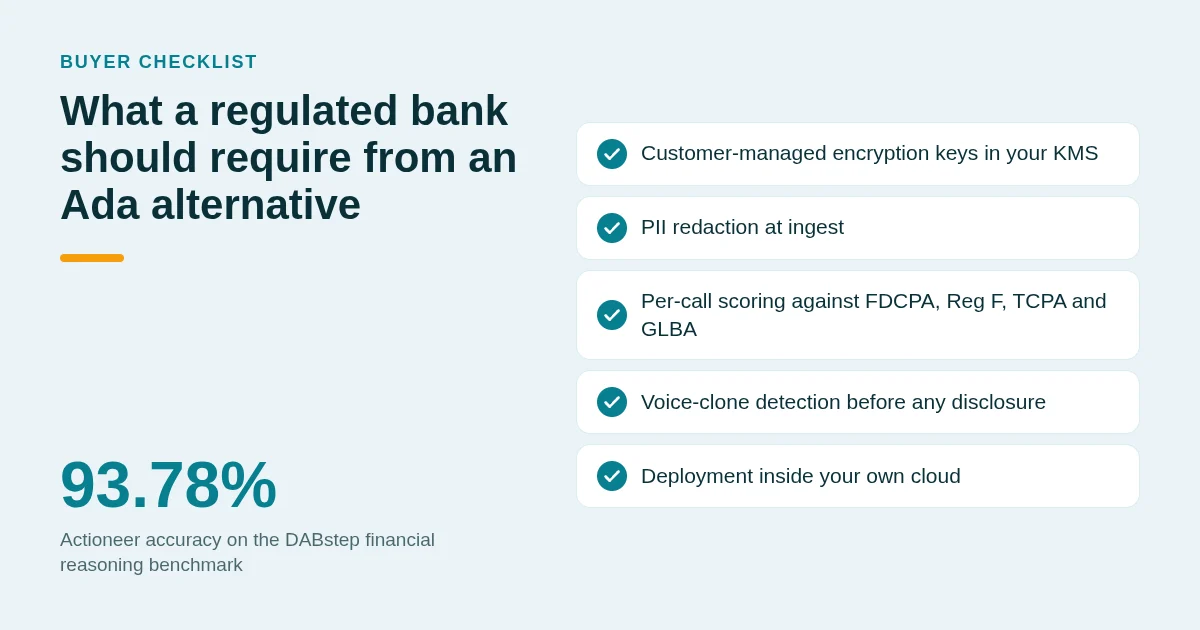
These Ada alternatives handle voice, integration and compliance unevenly. Actioneer, Cognigy, Kore.ai, Interface.ai and Glia lead on voice, while Kasisto, boost.ai and Intercom Fin are strongest in digital channels. Banks should require customer-managed encryption keys, PII redaction at ingest, deployment in their own cloud and per-call scoring against named regulations like FDCPA, Reg F and TCPA.
Start with the type of AI, because it determines the risk. Classic NLP platforms classify intents and follow scripted flows, which is predictable but brittle. Generative platforms draft replies from a knowledge base, which is flexible but can hallucinate. Agentic platforms plan multi-step actions against live systems, which is the most useful for banks and the most in need of guardrails. The NIST AI Risk Management Framework is a sound baseline for governing the last two.
Actioneer's approach is agentic with checks at both ends. The platform page documents how agents maintain conversation context across voice, SMS and other messaging channels, updating connected systems and handing off to staff when needed. Post-training of open-weight models uses verified events such as repaid instalments, with each update gated on compliance evaluations. Full methods are on our research page covering reasoning, evaluation and learning.
On data protection, require three things in writing. Encryption in transit at TLS 1.2 or higher and AES-256 at rest with customer-managed keys. Redaction of names, phone numbers, account numbers and health identifiers from analytics and training sets at ingest. And a deployment model that keeps data in your cloud; our security and deployment page lists how Actioneer does each. Card data handling should additionally meet PCI DSS, and any US collections conversation must follow Regulation F under the CFPB.
Voice adds one more test. Synthetic-voice fraud usually targets the disbursal account, so ask whether the vendor can tell a customer from a synthetic voice within the first seconds of an 8 kHz phone call. Actioneer treats that classification as a first step and restricts what the agent may disclose or change based on the result.
What should a bank evaluate when migrating from Ada to another platform?
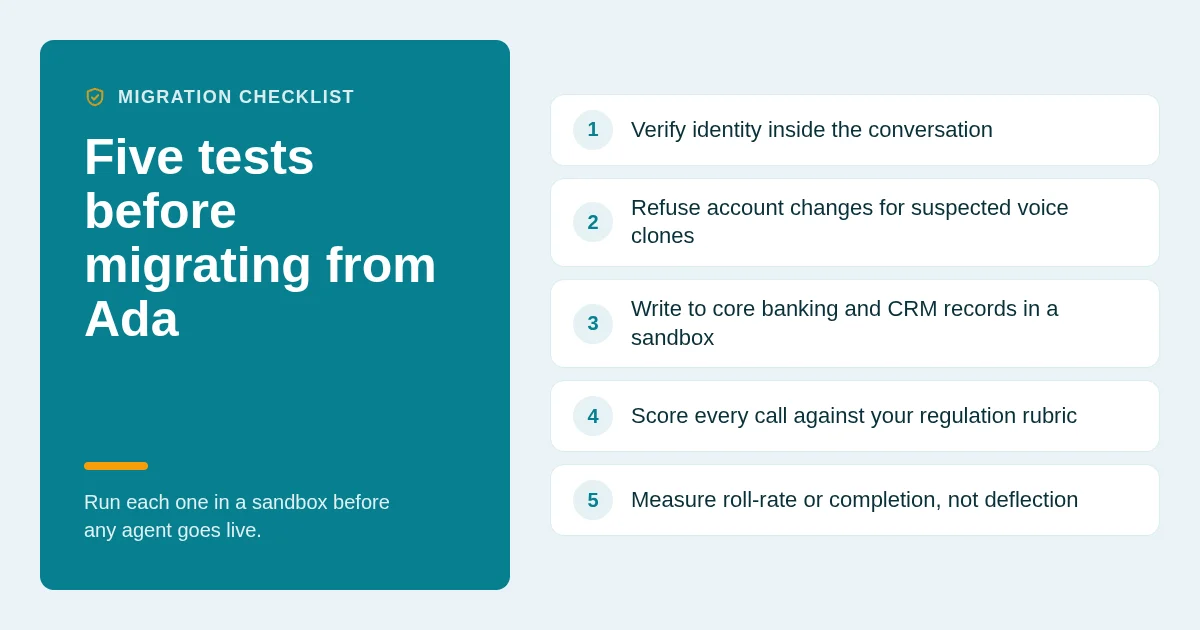
A bank migrating from Ada should test five things before go-live: identity verification inside the conversation, refusal behaviour for suspected voice clones, write access to core banking and CRM systems, per-call scoring against the bank's own regulation rubric, and a measured business outcome such as roll-rate. Vendors that cannot show all five in a sandbox are a risk.
Our own method, documented on the platform page, runs four stages for each customer: Know, Act, Measure and Learn. Know assembles account context and verifies the party. Act answers questions, sends reminders, takes payments and updates approved records. Measure scores every call against the bank's rubric. Learn post-trains on the outcomes that followed.
The Measure stage is where migration risk hides. For early-stage collections, our rubric checks six items on every call: right party verified first, assistant and purpose disclosed, within contact rules, no pressure or misleading statements, options offered within policy, and plan confirmed back. Any new agent version that fails a critical rule in testing is blocked before deployment. Ask every vendor to show the equivalent gate.
Measure the business outcome, not the deflection rate. Ask vendors to share case studies with measurable portfolio or operational metrics so you can compare results against your own baseline. That is a number an Ada resolution dashboard cannot produce.
A practical decision rule: if more than half of your automation value comes from answering inbound questions, an Ada-style platform or Kasisto is probably enough. If more than half comes from getting customers to complete something, choose an agent that can verify, act on records and prove compliance per call. Our voice AI evaluation checklist for BFSI sets out seven criteria drawn from real deployment failures.
How did we compare these options?
We compared the public product pages, documentation and pricing pages of each vendor as of November 2026, focusing on channel coverage, banking-specific features, deployment model, named compliance controls and whether a list price exists. Actioneer details come from our own platform, security, research and case study pages. Where a vendor publishes no price, we say so rather than estimate.
How do you get started with Actioneer?
Getting started with Actioneer begins with a scoped demo of one journey, such as stalled loan applications or early-stage collections, run against your rubric and your regulations. We show caller verification, voice-clone handling, per-call scoring and the account events that follow. Deployment then runs inside your own AWS, Azure or Google Cloud environment.
Book a demo with Actioneer to see a lending or collections agent handle a live scenario against your rules.
What do people also ask?
What type of AI is used in banking?
Banks use three types. Intent-based NLP classifies requests and runs scripted flows, generative LLMs draft answers from knowledge bases, and agentic systems plan multi-step actions against core banking records. Actioneer uses the agentic approach, post-training open-weight models on verified outcomes such as repaid instalments, with each update gated on compliance evaluations.
What are the top 5 core banking software solutions?
The most widely deployed core banking platforms as of November 2026 are Temenos, FIS, Fiserv, Finastra and Oracle FLEXCUBE, with Infosys Finacle also common in Asia. When evaluating an Ada alternative, ask the vendor to show a live read and write against whichever of these your bank runs, not just a connector logo.
What are the 7 types of banks?
A common breakdown lists central banks, commercial or retail banks, investment banks, credit unions, savings and loan institutions or thrifts, online-only or neobanks, and community or cooperative banks. Automation needs differ by type: credit unions and community banks often choose Interface.ai or boost.ai, while lenders with collections books need outbound agents like Actioneer.
What improvements would you suggest for digital banking?
Three improvements move the most value: verify identity inside the conversation so agents can act on accounts rather than just answer, follow up on stalled tasks such as incomplete loan applications across days and channels, and score every interaction against named regulations like FDCPA, TCPA and GLBA so compliance is checked per call instead of sampled.
Is Actioneer a direct replacement for Ada in a bank?
Not one-for-one. Ada resolves inbound support conversations on chat, email and voice. Actioneer runs agents that finish account tasks across calls and messages, such as following up on stalled loan applications, explaining document checklists, directing borrowers to secure uploads and escalating hardship, deployed in the bank's own cloud with TLS 1.2 or higher in transit and AES-256 at rest. Banks that mainly need web chat deflection may keep Ada or pick Kasisto.