
If you are weighing Actioneer vs Ada customer service AI, here is the short version. Pick Actioneer when the job is finishing a customer task in a regulated industry across calls, texts and days, with caller verification, per-call rubric scoring and deployment inside your own cloud. Pick Ada when you need an omnichannel, AI-first support platform that resolves high volumes of inbound tickets for e-commerce or SaaS. Actioneer is not a helpdesk chatbot, a ticketing system or a generic FAQ bot; it is a lifecycle agent platform for lenders, insurers and healthcare providers. Ada does not publish a price list.

Key takeaways:
- Different jobs: Actioneer runs multi-step customer journeys through Know, Act, Measure and Learn stages for lending, insurance and healthcare; Ada automates inbound support resolution across chat, email, voice and SMS.
- Your cloud, your keys: Actioneer deploys in your cloud with TLS 1.2 or higher in transit, AES-256 at rest and customer-managed keys in AWS KMS, Azure Key Vault, Google Cloud KMS or an on-premises HSM; Ada is vendor-hosted SaaS.
- Voice fraud: Actioneer classifies a caller within the first seconds of an 8 kHz phone call as a verified borrower, an authorised third party or a suspected voice clone, and refuses disbursal and mandate changes on suspected clones.
- Pricing: Ada sells quote-based enterprise contracts and does not publish a price. Intercom Fin lists $0.99 per resolution on its public pricing page; confirm current pricing on Intercom's site before budgeting.
What is Actioneer, and how does it differ from Ada's customer service AI?
Actioneer builds AI agents that finish customer tasks across calls, channels and days for insurers, lenders and healthcare providers, running each customer through Know, Act, Measure and Learn stages. Ada is an omnichannel, AI-first customer service platform that uses generative AI agents to resolve inbound support conversations across chat, email, voice and SMS.
Actioneer is a product of Glitchcraft Inc. Its agents handle the work between a customer's first enquiry and the outcome: a loan that gets disbursed, a claim that gets settled, a prescription that gets collected. We describe the four stages on our page on how customer lifecycle agents work.
In practice an agent can answer questions, send reminders and book appointments, take payments and update approved records, and ask for verification or hand off to your team. For insurance, the agent handles document collection by sending secure upload links, checking the submission, requesting another copy if needed, updating the claim file and routing to the claims team. Adjusters decide coverage and settlement. The key word is approved. Every write action is bounded by the rules you set for that agent and checked on every call.
Ada, headquartered in Toronto, approaches the problem from the inbound side. Its AI Agent reads your help center and connected systems, then resolves customer questions across chat, email, voice and SMS, reporting success as automated resolutions. That makes Ada a natural fit for retailers, subscription businesses and SaaS companies with large ticket volumes and well-documented policies.
The simplest decision rule: if your biggest cost is inbound tickets that repeat, start with Ada. If your biggest cost is customer tasks that stall between touchpoints, start with Actioneer.
Where do Actioneer, Ada and three other customer service AI platforms each fit?
Each platform below fits a different job. Actioneer fits regulated, multi-step customer journeys. Ada fits high-volume omnichannel inbound support. Intercom Fin fits SaaS teams already on Intercom. Zendesk AI agents fit Zendesk helpdesk customers. Sierra fits consumer brands that want outcome-priced voice and chat agents. The descriptions below reflect the job each tool is built for, not a ranked ordering.
-
Actioneer: built for customer tasks that span calls, texts and days in a regulated industry. Regulations are written into each agent's rules and checked on every call: FDCPA and Reg F, TCPA, GLBA, ECOA and Reg B and UDAAP in the United States, the RBI Digital Lending Directions 2025 and DPDP Act 2023 in India, and CBUAE and SAMA consumer protection rules in the Gulf. Honest limit: Actioneer is built for insurance, lending and healthcare, so an e-commerce team that needs order tracking and returns automation will find Ada or Intercom a closer fit.
-
Ada: built for omnichannel inbound support automation at volume. Ada covers chat, email, voice and SMS from one AI Agent and integrates with helpdesks such as Zendesk and Salesforce and commerce platforms such as Shopify. Honest limit: pricing is quote-based and unpublished, and the platform is vendor-hosted rather than deployed in your cloud, which matters for data residency.
-
Intercom Fin: built for SaaS support teams already running Intercom. Fin is listed at $0.99 per resolution on Intercom's public pricing page; confirm current pricing on Intercom's site before budgeting. Honest limit: Fin is strongest inside Intercom's own inbox and messenger, so teams on another helpdesk give up part of its value.
-
Zendesk AI agents: built for teams that run Zendesk Suite and want automation without a new vendor. Zendesk prices AI agents as an add-on measured in automated resolutions, with no public per-unit rate on enterprise plans. Honest limit: the agents are coupled to Zendesk's ticketing model, so actions in systems outside the helpdesk take more configuration.
-
Sierra: built for consumer brands that want outcome-based voice and chat agents. Sierra sells on outcome-based pricing and publishes no price list. Honest limit: it is enterprise-only with no self-serve tier and does not offer deployment inside the customer's own cloud.
| Option | Built for | Pricing or format | Standout limit |
|---|---|---|---|
| Actioneer | Multi-step journeys in lending, insurance and healthcare | Deployed in your cloud | Not a general helpdesk or e-commerce returns bot |
| Ada | High-volume omnichannel inbound support | Quote-based enterprise contracts, vendor-hosted SaaS | Price not published; not deployable in your cloud |
| Intercom Fin | SaaS teams on Intercom | $0.99 per resolution (confirm on Intercom's site) | Strongest only inside Intercom's inbox |
| Zendesk AI agents | Zendesk Suite customers | Add-on priced per automated resolution | Coupled to Zendesk ticketing |
| Sierra | Consumer brands wanting outcome-priced agents | Outcome-based, no public price | Enterprise-only, no self-serve |
What happens when an Actioneer or Ada agent has to act, speak or hand off?
Both platforms take actions, not just answer questions, but in different domains. Actioneer agents verify identity, take payments, update approved records, book appointments and hand off to your team, with the caller classified in the first seconds of a phone call. Ada agents look up orders, process refunds and update accounts through helpdesk and commerce integrations, escalating to humans.
Can each tool actually take actions, or only answer questions?
Both take actions. Actioneer's write actions include taking a payment, confirming a repayment plan, booking an appointment and updating records you have approved for agent edits. On a lending account, the agent also sets what it may disclose or change before any balance or due date is read out. For insurance claims, the agent sends secure upload links, checks document submissions, requests another copy if needed, updates the claim file and routes to the claims team; adjusters decide coverage and settlement.
Ada's actions run through its integrations: an order lookup in Shopify, a refund in the helpdesk, an account update in the CRM. For e-commerce questions such as where is my order, returns and subscription changes, Ada's pre-built actions are the more direct path.
The gap shows up in multi-step planning. Actioneer plans calls and messages over weeks using data from core banking, policy and pharmacy systems, maintaining conversation context across voice, SMS and other messaging while updating connected systems and handing off to staff when needed.
How does each platform handle voice and caller verification?
Voice is where Ada's recent product push is concentrated. Its voice agent targets IVR modernization, replacing menu trees with a conversational agent that resolves calls or routes them. For inbound support lines, that is a sound use case.
Actioneer treats voice as a risk surface first. The platform tells a customer apart from an AI assistant or a synthetic voice within the first seconds of an 8 kHz phone call, across the languages we support. A caller is classified as a verified borrower (date of birth and registered number checked), an authorised third party (authority on file checked, status answers only) or a suspected voice clone, in which case disbursal and mandate changes are refused and the audio goes to your fraud team.
You can see this flow on our page on lending agents for each stage of a loan. The design reflects where voice fraud lands: voice-clone attempts usually target the disbursal account. A support-first voice agent is not built to make that call.
How does escalation and quality control work on each platform?
Ada escalates to human agents through its helpdesk integrations, carrying the transcript into the agent's inbox, and offers conversation review tools so support leads can audit what the AI said. For most support teams that is adequate control.
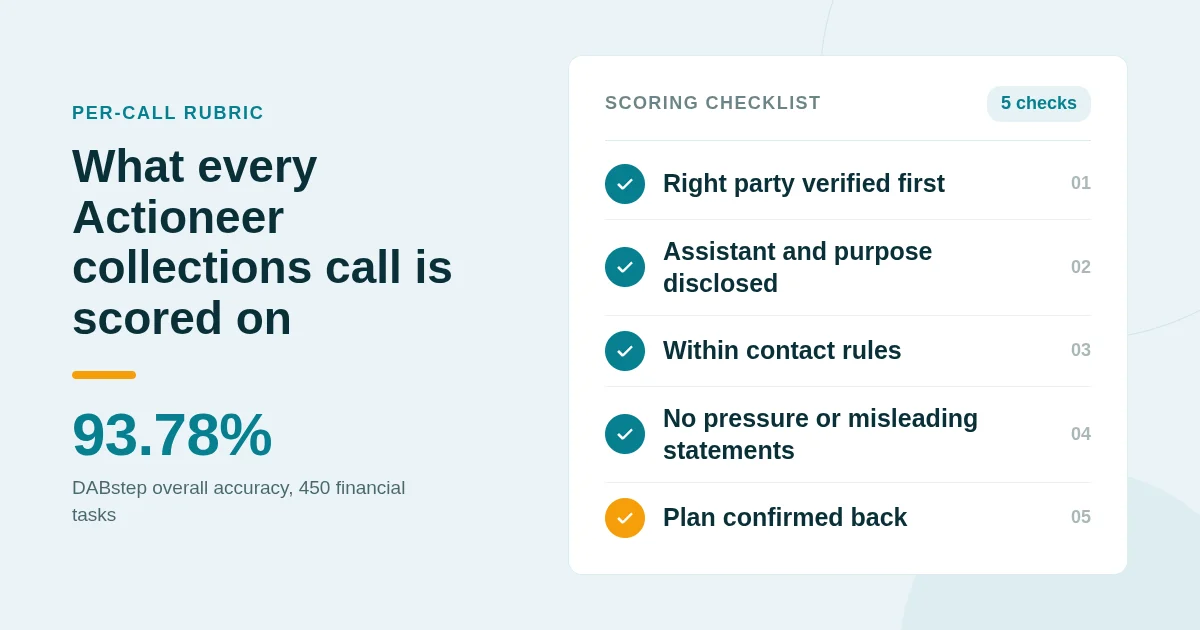
Actioneer scores every live call and message against your rubric. An early-stage collections rubric checks that the right party was verified first, the assistant and its purpose were disclosed, contact rules were respected, no pressure or misleading statements were made, options were offered within policy and the plan was confirmed back. Calls are scored deterministically where a rule can be checked, and model judges are calibrated against human QA reviewers where it cannot.
The release gate matters as much as the per-call score. Before deployment, any new agent version that fails a critical rule in testing is blocked. That maps to the measure and manage functions in the NIST AI Risk Management Framework, which asks organisations to test AI systems against documented criteria before and during operation.
Is Actioneer or Ada stronger on security, compliance and enterprise scale?
Actioneer deploys inside your own cloud, encrypts with TLS 1.2 or higher in transit and AES-256 at rest, uses customer-managed keys, and redacts names, phone numbers, account numbers and health identifiers at ingest. Ada runs as a vendor-hosted SaaS with its own certifications. For regulated data residency, Actioneer's model is the stricter default.
How does each platform protect customer data?
Actioneer runs in your cloud. Data is encrypted with TLS 1.2 or higher in transit and AES-256 at rest, with customer-managed keys held in AWS KMS, Azure Key Vault, Google Cloud KMS or an on-premises HSM. Names, phone numbers, account numbers and health identifiers are masked in analytics and removed from training sets at ingest. Full details are on our security and deployment in your cloud page.
Ada is hosted by Ada. It publishes its own security certifications and supports regulated customers on its enterprise tier, and for most retail and SaaS teams a well-certified SaaS vendor is the right trade-off. The difference is control: with Actioneer the keys and the data stay in your tenancy.
For healthcare buyers, the practical test is whether protected health information is kept out of logs and model training; the HHS HIPAA guidance is the reference point. Actioneer's redaction at ingest is designed around that requirement.
Which regulations are written into agent behaviour?
Actioneer writes region-specific rules into each agent and checks them on every call. In the United States that covers FDCPA and Reg F, TCPA, GLBA, ECOA and Reg B and UDAAP. In India it covers the RBI Fair Practices Code, RBI Digital Lending Directions 2025, RBI recovery-agent guidelines, the DPDP Act 2023 and TRAI TCCCPR and DLT. In the Middle East it covers CBUAE Consumer Protection Regulation and Standards, UAE PDPL, SAMA Financial Consumer Protection Principles and KSA PDPL.
Reg F shows why this belongs in the agent's rules rather than a disclaimer. The CFPB's Regulation F restricts call frequency, requires specific disclosures and limits what a collector may say. An agent that cannot prove it followed those rules on each contact is a liability.
Ada's compliance posture is organised around data protection and accessibility standards rather than sector conduct rules, which fits its customer base. If you run collections, claims or patient outreach, ask any vendor to show per-call evidence, not the certificate.
How do the two platforms scale across languages and volume?
Ada is built for volume. Its AI Agent is designed to absorb spikes in inbound chat and email without adding seats, and it supports a broad set of languages listed on its site. For a retailer entering peak season, that elasticity is the main reason to buy.
Actioneer scales differently. The unit of work is a customer journey rather than a ticket, so volume means thousands of accounts, each with a planned sequence of calls and messages over weeks. Post-training of open-weight models on verified events such as repaid instalments and collected refills is gated on compliance evaluations before any update ships.
What should you budget for Ada and Actioneer, and what do rollout and ROI look like?
Ada does not publish pricing; it sells quote-based annual enterprise contracts, commonly structured around automated resolutions, so you should confirm current terms with Ada's sales team. For Actioneer, ask us about your deployment when you book a demo. Compare both against your cost per resolved outcome today, not against list price.
What does each pricing model actually look like?
Ada's pricing is not published. The company sells annual enterprise contracts, and the metric it reports on is automated resolutions, so expect a conversation about resolution volume, channels and contract minimums. Ask for the per-resolution rate in writing and for how a resolution is defined, because that definition drives the invoice.
This post does not cover Actioneer pricing. What an engagement involves depends on the journeys you want finished, the systems involved and the regions and regulations in play, so bring those details when you book a demo and we will talk them through with you.
The useful baseline is your current cost per resolved outcome, including human time, failed contacts and regulatory review. McKinsey's work on AI-enabled customer service frames the business case the same way: value comes from resolved interactions and lower cost to serve, not from seat reduction alone.
What integrations and implementation timeline should you expect?
Ada connects to Zendesk, Salesforce, Shopify and similar helpdesk, CRM and commerce systems, and it starts from your existing help-center content. Teams with a mature knowledge base and clean integrations go live fastest; teams with policy knowledge locked in people's heads take longer.
Actioneer connects to core banking, policy and pharmacy systems, because the agent needs account state to act. Implementation therefore includes mapping which records the agent may read and write and encoding your rubric. The timeline is set by that scoping work, and we would rather give you a scoped plan than a generic number.
What ROI and results can you expect from each?
Ada reports ROI in automated resolution rate and cost per ticket, and its customers typically measure deflection from a human queue. Ask for references in your vertical and for the resolution definition behind any headline percentage.
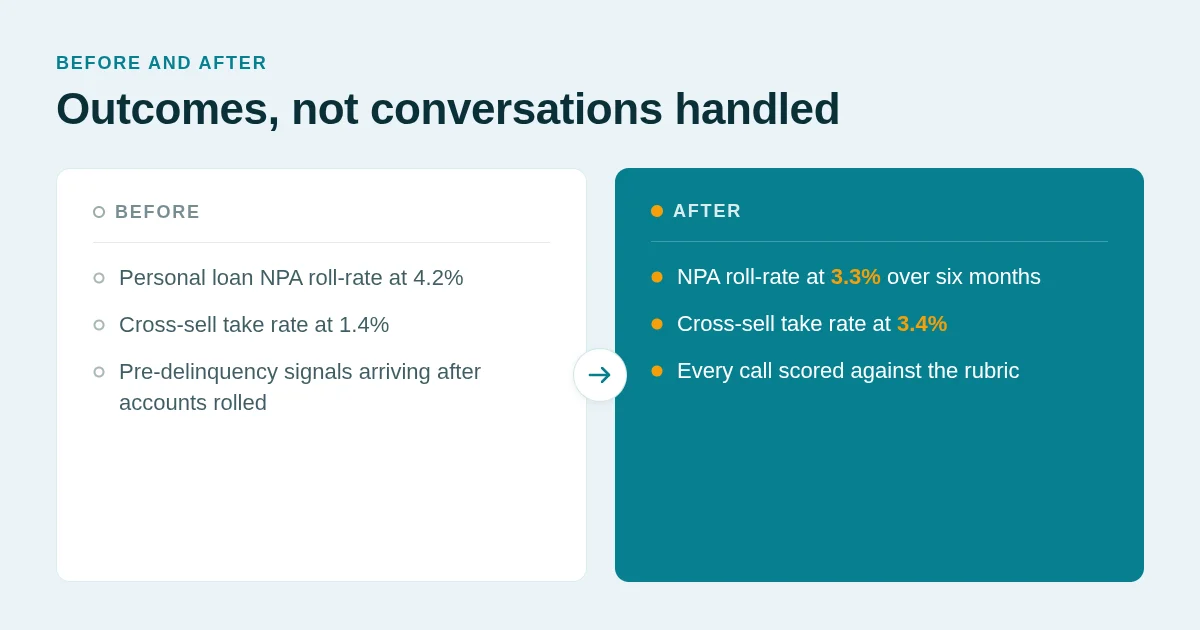
Actioneer reports ROI in account outcomes. The platform post-trains open-weight models on verified events such as repaid instalments and collected refills, and you can review calls and the account events that followed them to see where post-training could improve resolution rates. Those are the kind of numbers to demand from any vendor: outcomes in your ledger, not conversations handled.
Should you choose Actioneer or Ada for your team?
Choose Actioneer if you are a lender, insurer or healthcare provider whose customer tasks stall between touchpoints and whose regulators expect per-contact evidence. Choose Ada if you are an e-commerce, subscription or SaaS business with high inbound ticket volume and documented policies. Companies with both problems can run Ada for inbound support and Actioneer for lifecycle journeys.
By company size, the split is less about headcount than about data. A mid-sized NBFC with a core banking system and a collections rubric is a better Actioneer fit than a large retailer with none of those. A 20-person SaaS support team with a strong help center gets more from Ada or Intercom Fin on day one.
If you are migrating from an existing chatbot or IVR, note the difference in starting material. Ada starts from your articles and macros. Actioneer starts from your account systems, your contact rules and the outcomes you want measured, which is why it suits a lender replacing a dialler more than a store replacing a FAQ widget.
For e-commerce specifics such as order status, returns and dunning, Ada and Intercom have purpose-built actions. Actioneer handles dunning-style work only in its regulated form: early-stage collections with right-party verification and policy-bound options.
Where did the evidence in this Actioneer vs Ada review come from?
We compared the public product and pricing pages of Ada, Intercom, Zendesk and Sierra against Actioneer's platform, security and industry pages, focusing on scope, channels, action-taking, security posture, published pricing models and reported results. We did not run Ada's product or interview its customers, so Ada-specific claims are limited to what the vendor publishes.
What is the quickest way to test Actioneer against your own rules?
The fastest way to evaluate Actioneer is to bring one stalled journey, such as early-stage collections, claims follow-up or prescription refills, and the systems it touches. We will walk through how the agent verifies the caller, what it may change on the account and how every call is scored against your rubric.
Book a demo with Actioneer to see a lifecycle agent run against your own rules.
Actioneer vs Ada FAQ: what else do buyers ask?
What is the Ada AI agent?
Ada's AI Agent is a generative AI customer service agent that resolves inbound support conversations across chat, email, voice and SMS. It reads your help center and connected systems such as Zendesk, Salesforce and Shopify, takes configured actions like order lookups and refunds, and escalates to human agents when it cannot resolve the issue.
How much is Ada AI?
Ada does not publish pricing. It sells quote-based annual enterprise contracts, commonly structured around automated resolutions, so the cost depends on your resolution volume, channels and contract minimums. Ask Ada's sales team for the per-resolution rate in writing and for how a resolution is defined before comparing it with other vendors.
What is an AI customer support agent?
An AI customer support agent is software that uses large language models to understand a customer's request, pull context from your systems, and either resolve the issue or route it to a person. The capable ones take actions such as refunds, payments or record updates, verify identity first, and log every step for audit.
What does Auditoria AI do?
Auditoria.AI is a separate company that sells AI agents for finance back-office work, such as accounts payable, accounts receivable and vendor inquiries. It is not a customer service platform and is not a direct alternative to Actioneer or Ada; it appears in this search because its name is often confused with Ada.
Is Actioneer or Ada better for e-commerce customer support?
Ada is the better fit for e-commerce. It has pre-built actions for order status, returns and subscription changes and integrates with Shopify and common helpdesks. Actioneer is built for lenders, insurers and healthcare providers, where the work is multi-step journeys with caller verification and regulatory rules checked on every call.